





Every network installer eventually earns the same hard lesson: a PoE deployment can pass every test on day one and still fail the first time a storm rolls through. This guide walks through why that failure happens, what a properly engineered PoE adapter does differently, and how to match one to your own deployment.

Why Do High-Speed PoE Networks Fail Before They Ever Reach Full Speed?
The root cause is rarely the switch or the cable itself. It’s the PoE adapter sitting between them, struggling to deliver clean power alongside high-speed data.
Power and Data Are Competing for the Same Copper Wire
Power over Ethernet, or PoE, sends electrical power and data signals through the same cable pairs. Because of this, any instability in the power delivery can bleed directly into the data stream.
As Ethernet speeds climb from 1Gbps toward 10Gbps, the data signal becomes more sensitive to electrical noise. Therefore, the injector should be designed for PoE power delivery and high-speed Ethernet pass-through rather than treated as a conventional power adapter.
What Happens When Voltage Noise Bleeds Into the Signal Path?
When a power adapter has poor voltage regulation, ripple and electromagnetic interference leak into the data pairs. This causes packet loss, retransmissions, or a complete link failure on high-bandwidth connections.
For example, a security camera feed might freeze intermittently during peak network load. As a result, footage gaps appear at exactly the moments they’re needed most — a direct consequence of power-signal crosstalk.
Are Outdoor Installations More Exposed to These Failures?
Yes, outdoor Ethernet runs face compounded risk. Long cable spans act as antennas, picking up electromagnetic interference from nearby equipment, weather, and — most seriously — lightning activity.
|
Risk Factor |
Indoor PoE Run |
Outdoor PoE Run |
|
Cable length exposure |
Short, shielded |
Long, often unshielded |
|
EMI/noise sources |
Limited |
HVAC, motors, weather |
|
Surge exposure |
Minimal |
Direct/induced lightning risk |
Introducing the PoE35-560062 — A PoE Adapter Built to Solve These Exact Problems
This is exactly the gap UE Electronic set out to close. We have manufactured power adapters since 1989 and operate an EMC laboratory and in-house testing facilities.
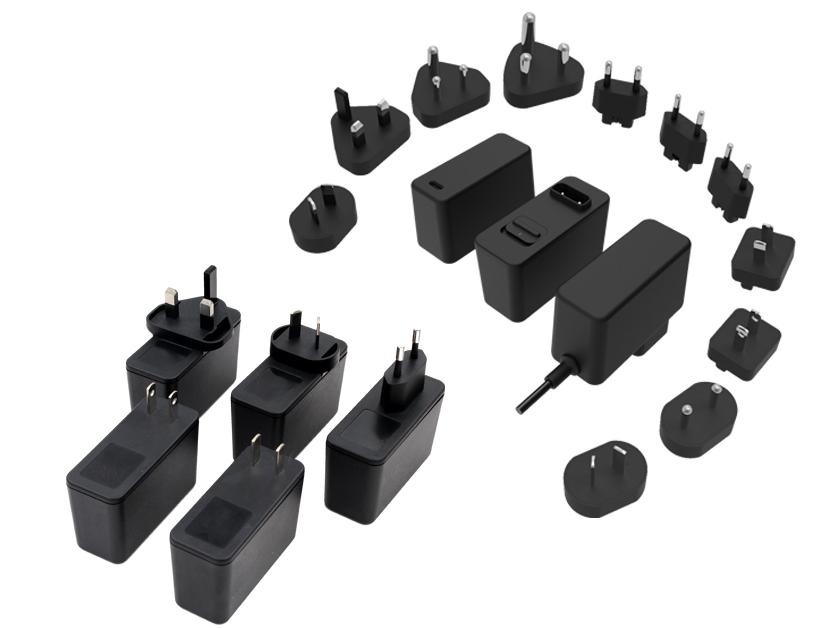
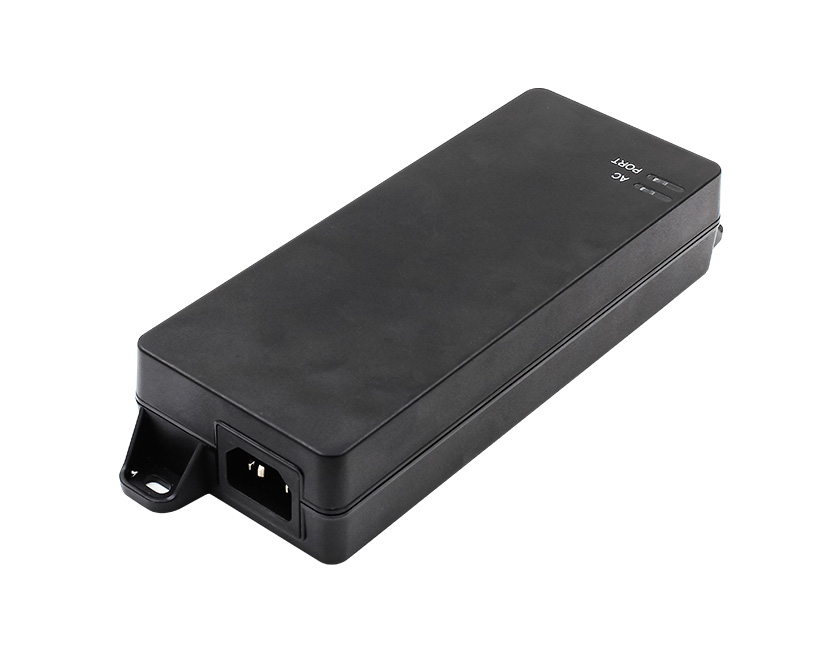
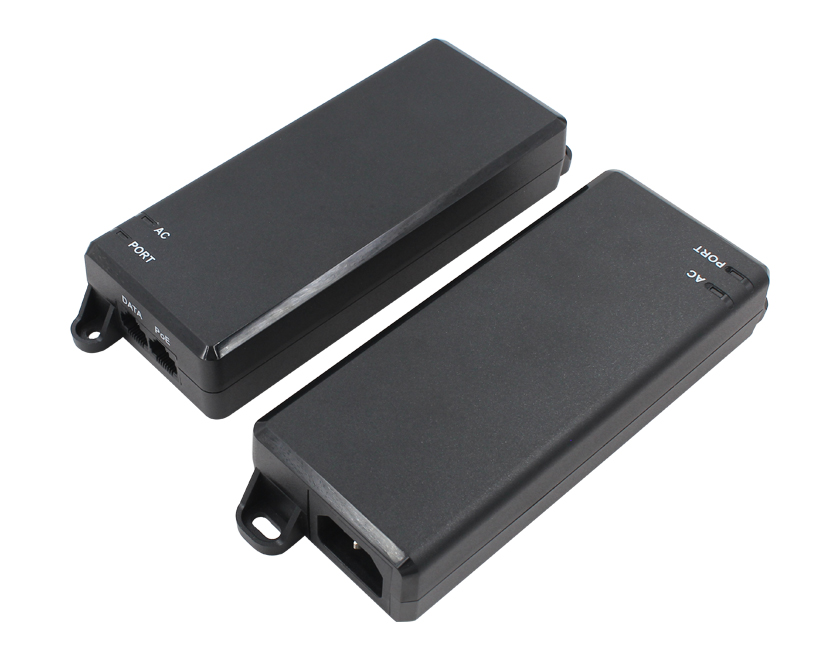
Its PoE35-560062 is a compact PoE power over ethernet adapter built specifically for the power-and-signal coexistence problem described above. It targets IP phones, wireless APs, POS terminals, and programmable cameras.
How Does This Adapter Keep 56V Power From Disrupting 10Gbps Data?
The PoE35-560062 delivers a regulated 56V DC output while maintaining Ethernet transmission integrity across 10Mbps, 100Mbps, 1G, 2.5G, 5G, and 10G speeds. Its output voltage stays within ±5% tolerance, which limits the ripple that would otherwise corrupt high-speed signaling.
Because it complies with the IEEE 802.3af/at protocol, it also interoperates predictably with existing PoE-powered devices. This protocol compliance matters because it guarantees the power negotiation between adapter and device follows an industry-recognized standard, not a proprietary shortcut.
The Core Specifications Behind Its Stability
The adapter’s average energy efficiency reaches 85% or higher, reducing wasted heat that could otherwise degrade nearby components over time. Below is a summary of its core specifications:
- Input voltage: 90-290VAC (global compatibility)
- Output: 56V DC, 0.01-0.62A (35W)
- Efficiency: ≥85% average
- Weight/dimensions: 205g, 171 × 62 × 31mm
- MTBF: 500,000 hours at 25°C (Telcordia SR-332 standard)
6kV Surge Protection Is the Difference Between an Outage and an Uneventful Storm
Outdoor Ethernet runs face a specific threat that indoor networks rarely encounter: induced lightning surges. Industry data shows that lightning accounts for roughly 20% of electrical surge events.
How Does an Indirect Strike Still Cause Damage?
Even an indirect strike can inject thousands of volts into a data line within microseconds, with the resulting electromagnetic pulse creating surge currents of tens of thousands of amps.
A second, often overlooked mechanism compounds this risk: ground potential rise, where the voltage difference between two ends of a cable during a lightning event drives destructive current straight into connected switches or cameras.
How Does the PoE35-560062 Stop This Before It Reaches the Device?
This is precisely why the PoE35-560062 carries a 6KV surge immunity rating alongside short circuit, overcurrent, and overvoltage protection. When a transient spike hits the line, these circuits clamp the excess voltage before it reaches the connected device.
This protects both the PoE switch power supply infrastructure and the endpoint hardware. For installers running cameras or access points on rooftops or poles — effectively small lightning rods — this protection layer isn’t optional.
Industrial-Grade Components Are What Make -25°C to 50°C Operation Possible
Surge events aren’t the only outdoor hazard; temperature extremes stress components just as heavily. The PoE35-560062 operates across a -25°C to 50°C range, with storage tolerance extending to -40°C and 85°C.
Why Do Component-Level Choices Matter More Than Enclosure Design?
Reaching this range requires component-level selection, not just enclosure design. Capacitors, for instance, must be rated for wide thermal cycling, since repeated expansion and contraction is what causes premature failure in lower-grade parts.
Humidity resistance matters equally. The adapter operates reliably from 5% to 95% humidity under non-condensing conditions, which suits rooftop enclosures, unheated cabinets, and coastal installations.
Is It Certified for Deployment Across Different Markets?
Combined with a full slate of global safety certifications — CE, cULus, CB, CCC, KC, RCM, BSMI, PSE, BIS, and NOM — this ethernet PoE adapter is positioned for deployment across varied regulatory markets, not just a single region.

Conclusion — Choose the PoE Power Supply That Matches Your Deployment
High-speed PoE networks fail for identifiable reasons: power and data sharing one cable, voltage noise corrupting signal, and a network adapter that wasn’t built for outdoor exposure amplifying both risks.
The PoE35-560062 addresses all three directly, pairing stable 56V delivery with 6kV surge immunity and a wide industrial operating range. For teams deploying cameras, access points, or POS terminals outdoors, this combination reduces the maintenance calls that come from preventable power failures.
Choosing the right PoE adapter ultimately comes down to matching the environment. Indoor, climate-controlled installations may tolerate a simpler unit, but any outdoor or industrial deployment benefits from the surge and temperature resilience built into this design.