





Today, Power over Ethernet (PoE) technology has become a cornerstone of modern network infrastructure. Unified, open IEEE standards, such as 802.3af, 802.3at, and 802.3bt, guarantee seamless interoperability across equipment from different vendors.
This empowers network administrators to build standardized, easily scalable environments, offering solid technical support for applications like the IoT, smart campuses, and digital workplaces. This article presents a comparative analysis of PoE standards.

Overview of POE
1. How Does POE Work
A PoE system consists of two core types of equipment:
(1) Power Sourcing Equipment (PSE)
Responsible for combining Ethernet data signals with DC power and delivering them over a network cable. PSEs are typically network switches (PoE switches) or midspan devices (such as PoE injectors).
Acting as the system’s power manager, the PSE intelligently detects whether a connected PD complies with PoE standards and only supplies power after verification.
(2) Powered Device (PD)
Refers to end devices that consume power, such as wireless access points, IP phones, and network cameras.
PDs incorporate built-in power management circuitry that extracts power from the network cable and automatically negotiates with the PSE to determine the required power level.
The entire power delivery process is intelligent and safe. PSEs do not supply power to non-PoE devices, thereby eliminating the risk of equipment damage.
2. Key Advantages of PoE
(1) Simplified Cabling
A single standard Ethernet cable handles both data transmission and device power delivery, dramatically reducing the number of cables and the complexity of cabling.
This benefit is especially pronounced in spaces where cabling is constrained or environments are challenging, such as ceilings or outdoor installations.
(2) Lower Costs
PoE eliminates the need to hire electricians for running AC power lines, installing power outlets, or purchasing power adapters. For large-scale deployments, these savings are substantial.
Additionally, centralized power distribution reduces energy consumption and simplifies uninterruptible power supply (UPS) setups, since only the network switches require backup power.
(3) Centralized Management
PoE integrates end devices into the network management system. Through network management software, administrators can remotely monitor the power status of each PoE port, perform remote reboots (via PoE port resets) when devices freeze, and dynamically allocate power based on priority. These capabilities significantly enhance operational efficiency and network reliability.
PoE Standard Comparison
The evolution of PoE standards reflects a significant increase in power delivery capabilities and technical sophistication to support a widening array of networked devices.
The three primary standards, IEEE 802.3af, 802.3at, and 802.3bt, differ primarily in their power budgets, the number of wire pairs used for transmission, and the types of devices they support.
1. IEEE 802.3af (Type 1)
Originally conceived to allow interoperability between manufacturers, this standard enables devices like standard VoIP phones, wireless access points, and basic security cameras to support up to 15.4W at the PSE and 12.95W at the PD. It delivers 44–57V DC (nominally 48V) power over two out of the four twisted wire pairs in a standard Category cable.
2. IEEE 802.3at (Type 2 / PoE+)
Ratified to expand upon the original standard, 802.3at increased the power budget to 30W at the source, allowing for more power-hungry devices such as panning security cameras (PTZ), video phones, and audio appliances. While it still utilizes only two wire pairs for power delivery, it introduced several enhancements:
- It is designed to support 1000BASE-T data links alongside 10BASE-T and 100BASE-TX, ensuring compatibility with Gigabit Ethernet infrastructures.
- It introduces LLDP support, which enables more granular power management by allowing dynamic power negotiation between the PSE and PD.
3. IEEE 802.3bt (Type 3 & 4 / PoE++)
This standard represents a major shift by utilizing all four wire pairs for power delivery, which significantly increases efficiency and power levels.
Type 3 supports up to 60W from the source and 51W at the device, suitable for Wi-Fi 6 access points and video conferencing endpoints.
Type 4 supports up to 90W (often marketed as “up to 100W”) at the source and 71.3W at the device, enabling high-power applications like large panel displays, building automation, and high-performance LED lighting systems.
New Features:
- Short Maintain Power Signature (MPS):Reduces the minimum standby power from 200mW to 20mW, which is essential for energy-efficient IoT devices.
- Autoclass: An optional feature where the PSE measures the actual power consumption of a PD during power-on to optimize power allocation across multiple ports.
- Single and Dual Signature Support: Supports both standard PDs (single) and devices with two independent, isolated power loads (dual), such as a camera with a separate heater.
- Increased Data Rates:Remains compatible with high-speed Ethernet standards (such as 10GBASE-T).
4. Compatibility and Cabling Requirements
Under standard-compliant implementations, all standards are designed to be backward compatible: an 802.3bt PSE can safely power 802.3at and 802.3af PDs, with the delivered power limited to the PD’s maximum supported level.
As power levels increase, heat dissipation becomes a critical concern. For high-power 802.3bt (Type 4) installations, it is recommended to use Cat6A cabling with 23 AWG solid copper conductors to minimize resistance and heat build-up, especially in large cable bundles.
The maximum recommended distance for PoE is 100 meters (328 feet) when using Category 5e or better cabling, in accordance with Ethernet channel specifications. Higher power levels (e.g., 802.3bt Type 4) may require higher-grade cabling to manage voltage drop and heat dissipation.
5. PoE Standards Chart
Feature | IEEE 802.3af (Type 1) | IEEE 802.3at (Type 2 / PoE+) | IEEE 802.3bt (Type 3 / PoE++) | IEEE 802.3bt (Type 4 / PoE++) |
Power Delivery Pairs | 2 pairs (1/2, 3/6) | 2 pairs (1/2, 3/6) | 4 pairs (all pairs) | 4 pairs (all pairs) |
PSE Output Power | 15.4W | 30W | 60W | 90W |
PD Available Power | 12.95W | 25.5W | 51W | 71.3W |
Typical Applications | VoIP phones, basic APs | PTZ cameras, video phones | Wi-Fi 6 APs, thin clients | Digital signage, high-power lighting |
Key New Features | Basic PoE | LLDP fine-grained management | 4-pair power delivery, Short MPS | Autoclass, dual-signature support |
Recommended Cabling | Cat5 or higher | Cat5e or higher | Cat6 or higher | Cat6A or higher (Cat6A recommended) |
Industry-Leading PoE Solution from UE Electronic
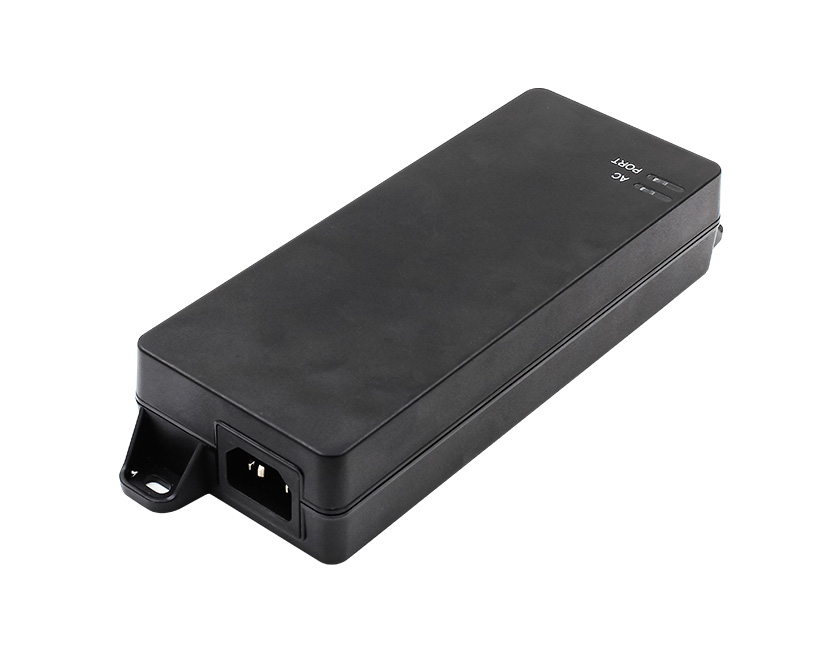
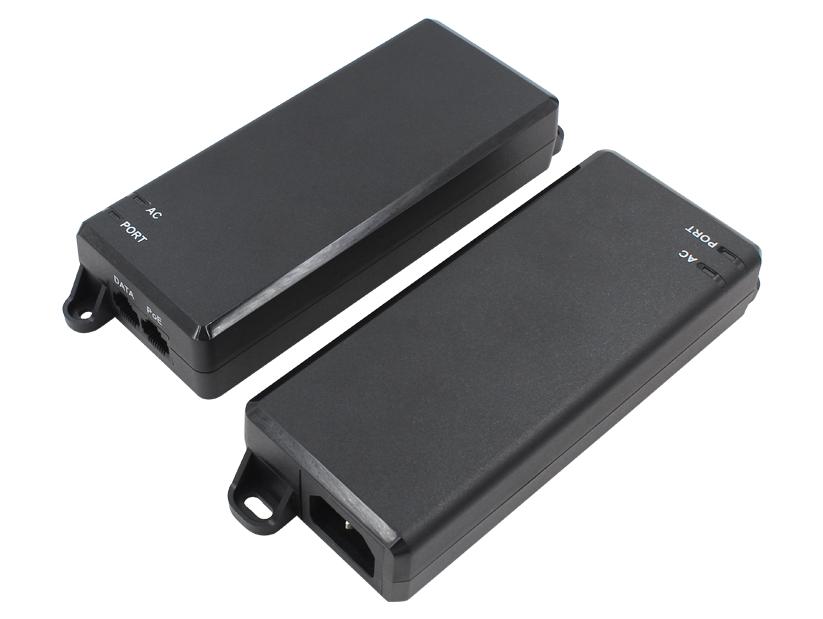
Based on the preceding in-depth analysis of PoE standards and addressing the needs of modern smart offices and industrial IoT, Our PoE35-560062 power adapter demonstrates exceptional industrial-grade quality across multiple dimensions:
1. Performance & Compatibility
- High-Efficiency Power: Fully compatible with IEEE 802.3af/at (Type 1 & 2), providing stable 56V output and up to 35W for PoE+ devices.
- Full-Rate Data: Supports 10/100/1000M (Gigabit) Ethernet, ideal for mainstream Wi-Fi 6 APs and UHD IP cameras (e.g., PTZ).
2. Ultimate Safety
- 6KV Surge Protection: Effectively resists power grid fluctuations and lightning risks to protect downstream devices.
- Smart Protection: Built-in short-circuit, over-current, and over-voltage protection with intelligent PD detection to prevent damage to non-PoE equipment.
3. Industrial Adaptability
- Extreme Environments: Operates reliably from -25°C to 50°C, suitable for unconditioned industrial or outdoor sites.
- High Reliability: Features an MTBF of 500,000 hours, ensuring long-term stability for mission-critical applications.
Conclusion
The evolution of PoE standards from the original 802.3af to the high-power 802.3bt has transformed how we design and deploy modern networks.
By merging data and power into a single, managed infrastructure, PoE offers unparalleled flexibility and cost-efficiency for the growing IoT landscape.
Selecting the right standard and high-quality hardware, like UE Electronic PoE35-560062, is essential to ensuring system reliability, safety, and future-proof performance in today’s demanding digital environments.