





Power density means nothing without thermal and electrical margin. This becomes particularly important when internal space is limited in medical equipment, communication devices, and other compact electronic systems. At UE Electronic, we approach miniature power design by considering output capability, thermal management, mechanical dimensions, and system integration together rather than treating size as an isolated specification.
What Determines Power Density in a Small Power Supply?
Power density describes how much output power a power supply can provide relative to the physical space it occupies. A smaller power supply with the same output rating can give an equipment designer more freedom to allocate space to other components, but achieving this requires careful control of electrical and thermal design.
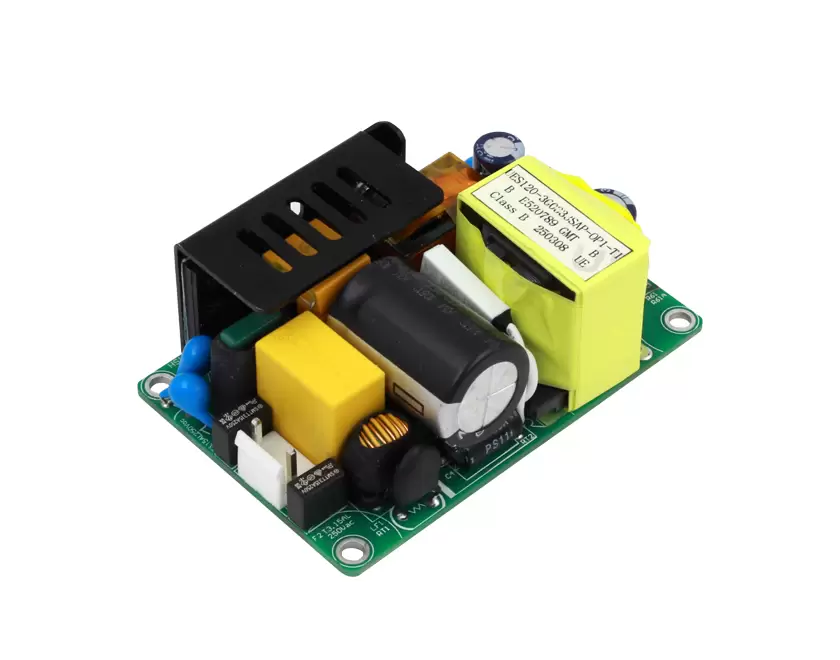
An open frame AC DC power supply can be useful in this context because the power conversion module does not need to include a complete external enclosure. Instead, it can be integrated into the host equipment’s own housing. This allows the equipment designer to consider the power supply as part of the overall mechanical architecture.
However, compact dimensions alone do not guarantee high power density. Designers also need to examine efficiency, cooling method, operating temperature, output configuration, and the relationship between rated power and available installation space.
Why Open-Frame Construction Supports Compact Integration
An open-frame structure removes the need for a separate finished enclosure around the power-conversion circuitry. This can reduce the physical volume occupied by the power module and give the OEM greater flexibility when designing the surrounding equipment.
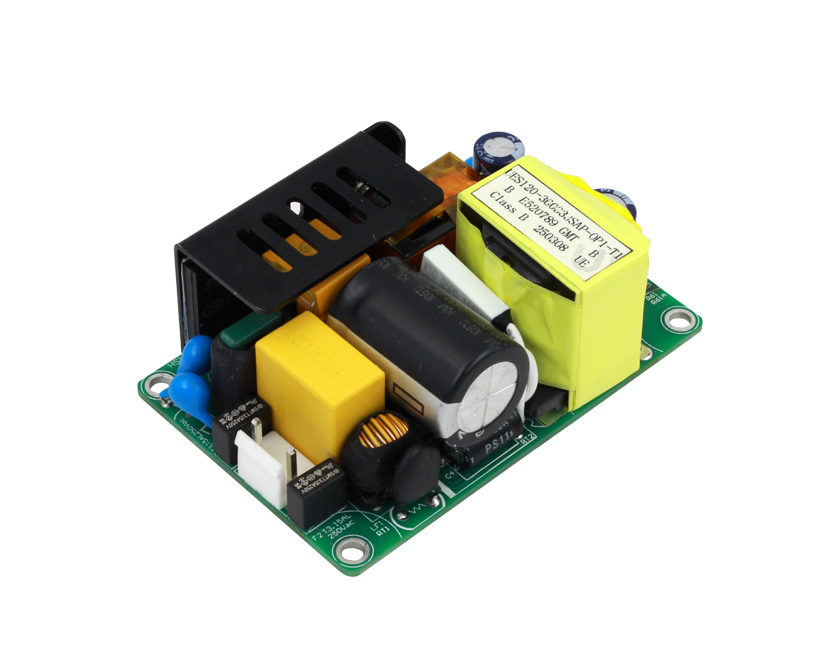
Our UES120-SPAZ-OP illustrates this approach. The product has mechanical dimensions of 76.2mm × 50.8mm × 31mm and weighs approximately 130g. Despite this compact form factor, the series provides a rated output of up to 120W across its available voltage configurations.
The combination is relevant for equipment where the internal power architecture needs to remain compact without moving the power supply outside the main enclosure. Because the module uses natural convection cooling, the host system’s thermal design becomes part of the integration process.
Efficiency Is Part of the Power-Density Equation
When a power supply converts AC input into DC output, some energy is inevitably dissipated as heat. Improving efficiency reduces the amount of input energy converted into waste heat at a given output load, which can make thermal management easier within a compact system.
The UES120-SPAZ-OP lists average efficiency from 92% to 95%, depending on the output model. The 12V and 15V versions are specified at 92%, while the 18V through 27V configurations are listed at 93%, and the 36V, 48V, and 54V versions reach 94% and 95% respectively. Standby power consumption is specified at no more than 0.5W.
For an OEM, these figures should be considered alongside the actual operating load and enclosure conditions. A compact power supply still needs sufficient airflow and appropriate spacing around heat-generating components. High efficiency can support the thermal strategy, but it does not eliminate the need for system-level thermal evaluation.
How We Balance Output Capability and Size
At UE Electronic, we provide the UES120-SPAZ-OP with multiple output configurations so that designers can select a voltage that corresponds to the requirements of the host equipment. The available versions include 12V/10A, 15V/8A, 18V/6.66A, 19V/6.31A, 24V/5A, 27V/4.44A, 36V/3.33A, 48V/2.5A, and 54V/2.22A.
These configurations demonstrate why output voltage and current should be evaluated together. Although the series is generally described as a 120W platform, the exact current and ripple specifications vary between models. For example, the 12V and 15V versions provide 120W with a maximum ripple of 150mVpk-pk, while the 48V and 54V versions specify 400mVpk-pk maximum ripple.
This allows the designer to select according to the electrical requirements of the application instead of assuming that every version has identical output characteristics.
Thermal Design Still Matters in a Miniature PSU
Compact power conversion concentrates electrical components into a relatively small area, making heat dissipation an important part of the design process. The UES120-SPAZ-OP uses convection cooling rather than an integrated fan. This can simplify the power module itself, but the final equipment must provide suitable conditions for natural airflow.
The product is specified for operation from -30°C to 85°C, with derating requirements from 40°C to 85°C. Its specified operating humidity is 5–90% RH, non-condensing, and the working altitude reaches 5,000 meters.
For engineers, these figures provide a framework for evaluating whether the power supply can operate within the intended environment. Mounting direction, surrounding components, enclosure ventilation, and expected load should all be considered during system integration.
Where Does a Miniature AC-DC PSU Fit?
The UES120-SPAZ-OP is designed for applications including oral irrigators, oxygen concentrators, ventilators, defibrillators, and other medical equipment, as well as communication-related equipment. Its safety specifications include 2 MOPP isolation protection and leakage current of no more than 100μA. The product page lists CB, TUV Mark, and NRTL safety standards associated with IEC 60601-1 and related medical requirements.
This application focus makes the selection process different from choosing a generic compact power module. The electrical output, isolation, safety certification, operating conditions, and host-equipment architecture all need to be considered together.
Making Compact Power Work at System Level
A compact AC DC open frame design achieves value when its small footprint contributes to a better overall equipment architecture. Reducing the module size while maintaining appropriate output capability, efficiency, safety characteristics, and thermal performance can give OEMs greater flexibility without separating the power supply from the requirements of the finished device.
At UE Electronic, we develop our power solutions with this system-level perspective. The UES120-SPAZ-OP combines a 120W output platform, compact 76.2 × 50.8 × 31mm dimensions, natural convection cooling, multiple voltage options, and medical-oriented safety features. For designers evaluating an open frame AC DC power supply, these characteristics provide a practical starting point for balancing power requirements with the limited space available inside modern equipment.