





When an OEM designs equipment with an internal battery, the power adapter has to do more than simply provide electricity to the device. It may need to power the equipment, support battery charging, accommodate different input environments, and meet the safety requirements of the finished product.
Such considerations are essential for medical and information-technology applications. At UE Electronic, we approach the adapter as part of the equipment’s power architecture rather than as a standalone accessory.
Why Does Battery Integration Change the Adapter Requirement?
A conventional AC-DC adapter may be designed around a fixed DC output, while battery-powered equipment requires coordinated power behavior for both the equipment and battery.
The UES12LCP-SPA incorporates functions such as constant current and conversion and is specified for use as a battery charger. Its output can be configured from 4V to 24V, with maximum power up to 12W.
For OEMs, this makes the adapter part of the battery-charging power path rather than simply an external source for the device’s electronics.
How Does a Universal AC Charger Adapter Support Different Battery Systems?
Universal ac charger adapter offer flexibility on multiple fronts. The UES12LCP-SPA accepts 90–264VAC input, covering a broad AC input range within its specified operating conditions. Its output range extends from 4V to 24V, allowing different voltage configurations to be considered for equipment with different power requirements.
The specification table provides output-current ranges for different voltage settings. For example, the 4.0–5.0V range supports up to 2.00A, while the 12.1–13.0V range supports up to 0.94A. At 23.1–24.0V, the maximum specified current is 0.50A. OEMs should therefore evaluate voltage, current, and total power together when determining whether the adapter can support both equipment operation and battery charging.
Why Are Interchangeable AC Pins Useful for OEMs?
Battery-powered equipment may be distributed across multiple countries, making regional AC connectivity an engineering consideration from the beginning of product development.
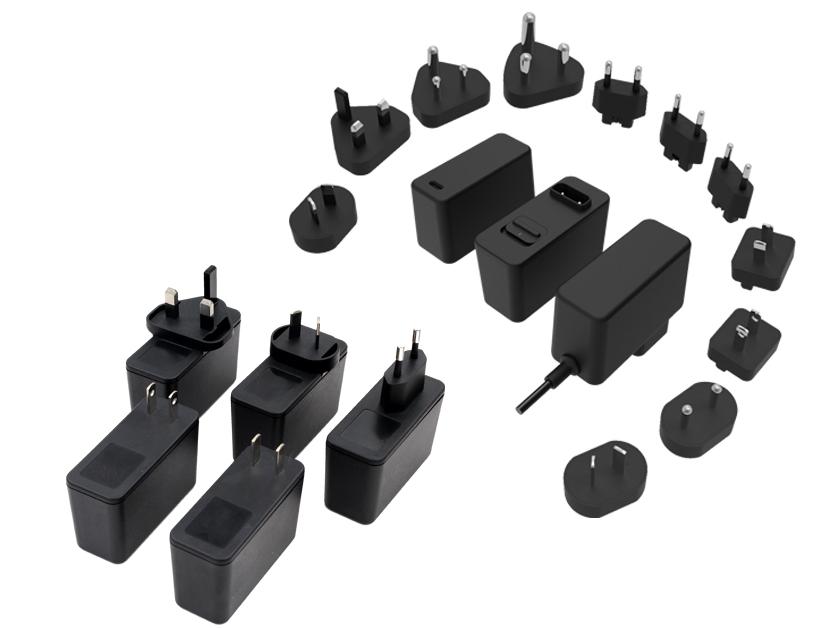
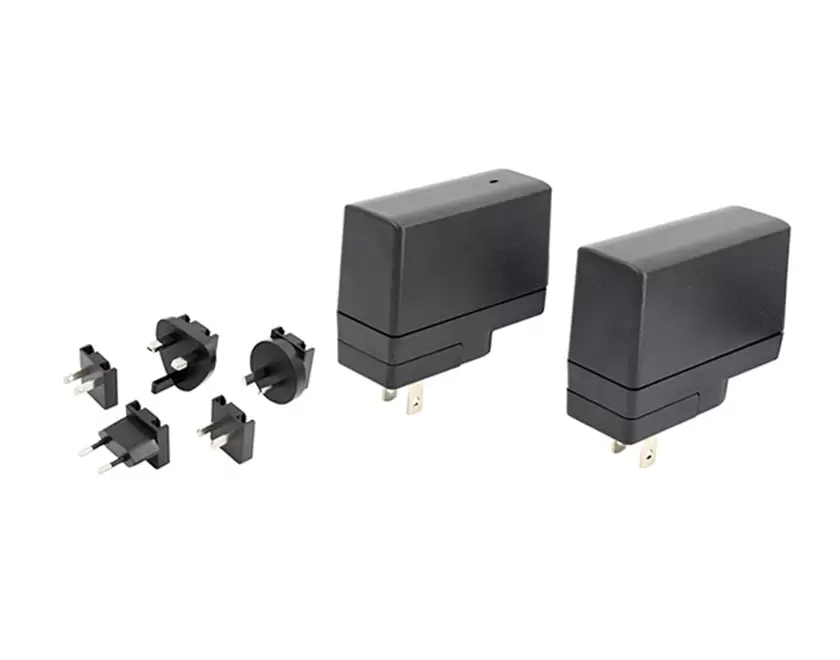
The UES12LCP-SPA is equipped with various interchangeable AC pin styles. Allowing the same adapter platform to support different regional AC interfaces.
For an OEM, this approach can separate the regional AC connection from the core power-conversion design. The manufacturer can establish the required output and charging characteristics for the equipment and then select the appropriate plug configuration for the target market.
What Happens When the Equipment Is Charging and Operating?
The adapter’s available output power needs to be sufficient for the intended operating conditions and charging requirements.
The UES12LCP-SPA has a maximum rated power of 12W. For example, the product can be configured around 5V/2A, 12V/1A, or 24V/0.5A within the published output ranges.
An OEM should therefore evaluate the adapter against the complete power budget instead of assuming that a nominal voltage automatically defines charging capability. The actual battery-management architecture, charging requirements, and equipment load remain system-level design considerations.
Why Does Low Leakage Current Matter?
For medical equipment, electrical isolation and leakage current can be important when the power supply is used in regulated environments.
The UES12LCP-SPA provides 2 MOPP isolation protection and is specified with leakage current of no more than 10μA. The product is also described as complying with medical device BF-level requirements and carries safety certifications covering applicable medical and I.T.E. standards.
These characteristics do not replace the compliance assessment of the finished equipment, but they give OEM engineers important parameters when evaluating the power stage during product development.
How Do Efficiency and Standby Power Affect Battery-Based Equipment?
Battery-powered equipment can spend considerable time connected to an external adapter without drawing its maximum rated power. Under these conditions, standby consumption and efficiency become relevant to the overall energy behavior of the system.
The UES12LCP-SPA specifies standby power consumption of no more than 0.075W and complies with DoE Level VI energy-efficiency requirements and CoC V5 Tier 2. The product’s average efficiency varies by output configuration; for many of the listed output ranges, the specification gives 83.30%.
These figures should be considered alongside the actual load profile, charging strategy, and operating conditions.
Does the Physical Design Matter to Battery Management?
The adapter’s physical characteristics can influence how easily it fits into a complete product ecosystem, particularly when equipment is portable.
The UES12LCP-SPA measures 76.0 × 30.3 × 48.2mm and weighs approximately 120g. Its specified operating temperature is -5°C to 45°C, with operating humidity of 10–90% RH without condensation. The specified working altitude reaches 5,000 meters.
The product also includes short-circuit, overvoltage, and overload protection, providing additional protection functions within the adapter itself.
What Should OEMs Evaluate Before Choosing an Adapter?
A battery-powered product should not be matched to an adapter using output voltage alone. OEMs should consider AC input range, DC output, maximum current and power, charging behavior, regional plug configuration, isolation, leakage current, efficiency, dimensions, and operating environment.
The intended battery system also matters. The UES12LCP-SPA can provide constant-current and constant-voltage functions, but the complete charging strategy still needs to be compatible with the battery and the equipment’s system architecture.
For medical and I.T.E. equipment, applicable safety standards should likewise be considered early rather than after the adapter has already been selected.
Building a More Flexible Power Architecture
The value of a universal ac charger adapter for OEMs comes from combining several requirements into one configurable power platform.
The UES12LCP-SPA brings these characteristics together with 90–264VAC input, 4–24V output, up to 12W power, 2 MOPP isolation, ≤10μA leakage current, low standby consumption, and battery-charging functions.
At UE Electronic, we provide this type of adapter as a practical option for OEMs integrating external power and battery charging into medical, I.T.E., and other equipment platforms. By evaluating the adapter’s electrical, charging, safety, and regional characteristics together, manufacturers can make a more informed decision about how the power stage should support the finished product.