

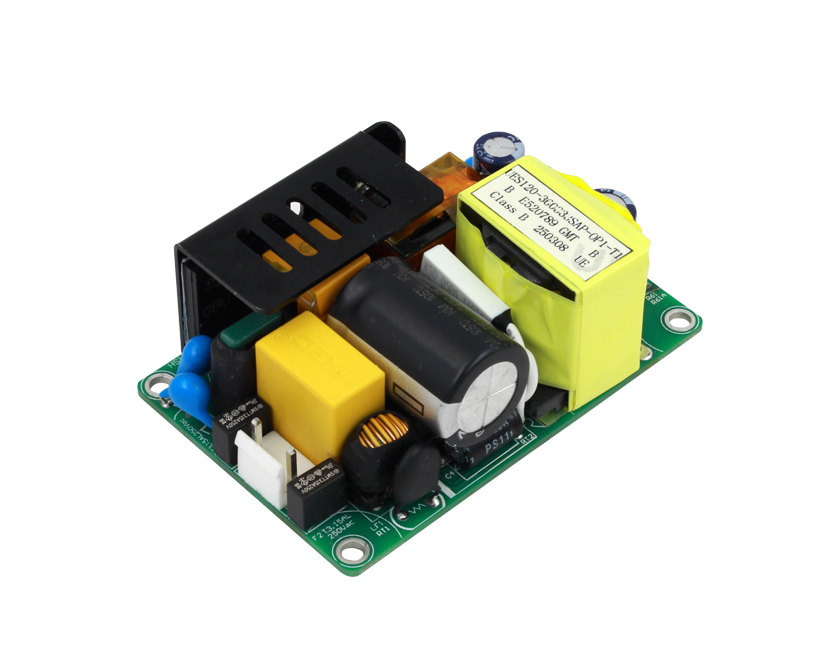






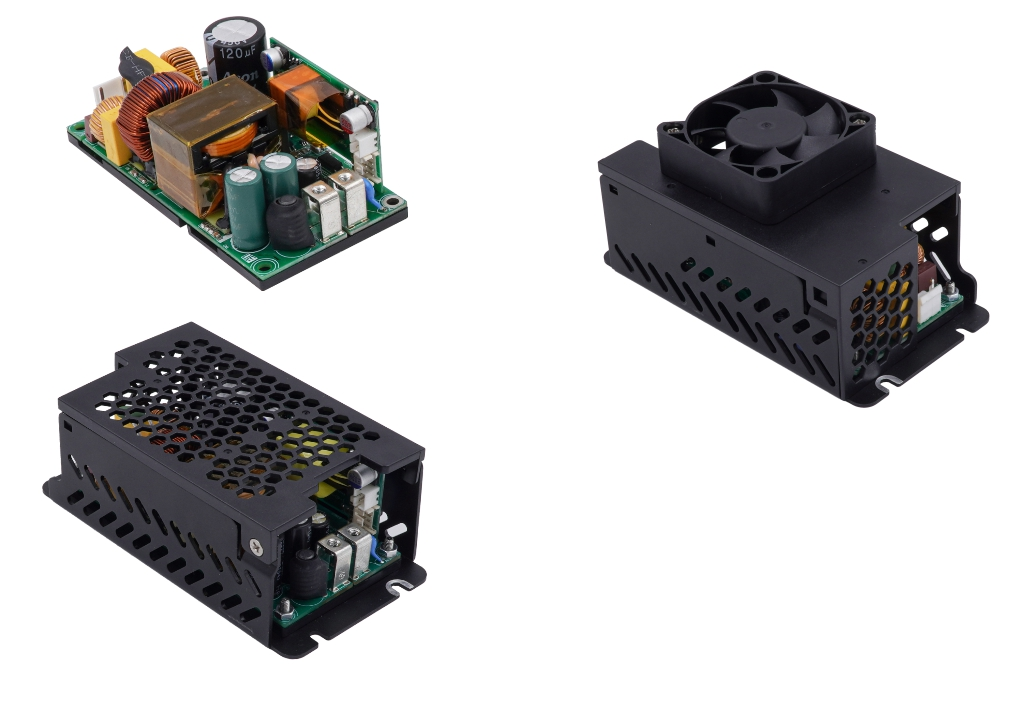
Consider the internal architecture of many modern electronic systems, from industrial controls to networking hardware. Within these assemblies, a common power solution is employed not as a standalone box, but as an integrated board-level component. This is the purpose of an open frame power supply. At UE Electronic, we design these units to function as the embedded power foundation within a larger piece of equipment. An open frame power supply is characterized by its construction: a printed circuit board (PCB) populated with all necessary power conversion components, mounted on a metal frame or chassis, but lacking a full, sealed enclosure.
The Fundamental Design and Integration Approach
The defining feature of an open frame power supply is its minimalist mechanical design. By omitting a full cover, the design achieves a compact form factor and reduces material use. This construction allows for direct integration into the end product’s enclosure, where the system’s overall casing provides the final protection. The design inherently promotes efficient thermal management, as heat-generating components like transformers and MOSFETs are exposed to the airflow managed by the host system’s fans or vents. For original equipment manufacturers (OEMs), this means the open frame power supply becomes a module within their own design, offering flexibility in placement and cooling strategies that a fully enclosed unit might restrict.
Primary Application as an I.T.E. Power Supply
The predominant application for this form factor falls under the category of Information Technology Equipment (I.T.E.). An ITE power supply is engineered to meet safety standards, such as UL/EN/IEC 62368-1, which govern equipment for telecom, networking, computing, and office environments. An open frame power supply is inherently suited for this role, as it is designed to be installed inside another device that provides the required safety barriers. When we develop an open frame power supply for I.T.E. applications, the focus includes achieving high efficiency, power density, and compliance with relevant EMC directives, all within the constraints of the open-frame architecture. This makes the ITE power supply in an open-frame style a standard component in servers, routers, and industrial computers.
Key Design Considerations and Trade-offs
Selecting an open frame power supply involves specific engineering considerations. The exposed PCB requires that the host system’s design prevent accidental contact with live parts, typically achieved through spacing, shrouding, or the use of insulated cabling within the final product. Furthermore, because the unit relies on the system for final airflow, thermal planning is a shared responsibility between the power supply designer and the OEM integrator. Electromagnetic compatibility (EMC) performance must also be carefully managed through PCB layout and filtering on the board itself, as there is no external metallic enclosure to provide shielding. A well-designed open frame power supply will account for these factors, providing a robust and reliable ITE power supply module ready for system integration.
An open frame power supply represents a modular and integrated approach to power delivery within larger electronic systems. Its value lies in its compact size, efficient thermal performance, and suitability for high-volume integration into equipment classified as I.T.E. For designers, it offers a different set of advantages and considerations compared to enclosed models, emphasizing collaboration between the power supply provider and the system architect. At UE Electronic, our development of these power supplies focuses on delivering reliable, compliant, and efficient modules that serve as a solid electrical foundation for our clients’ products.